Rapid Responders & Community Programs Continuum
A Peer-Led, EMS-Integrated Model for Post-Overdose Response and Long-Term Recovery
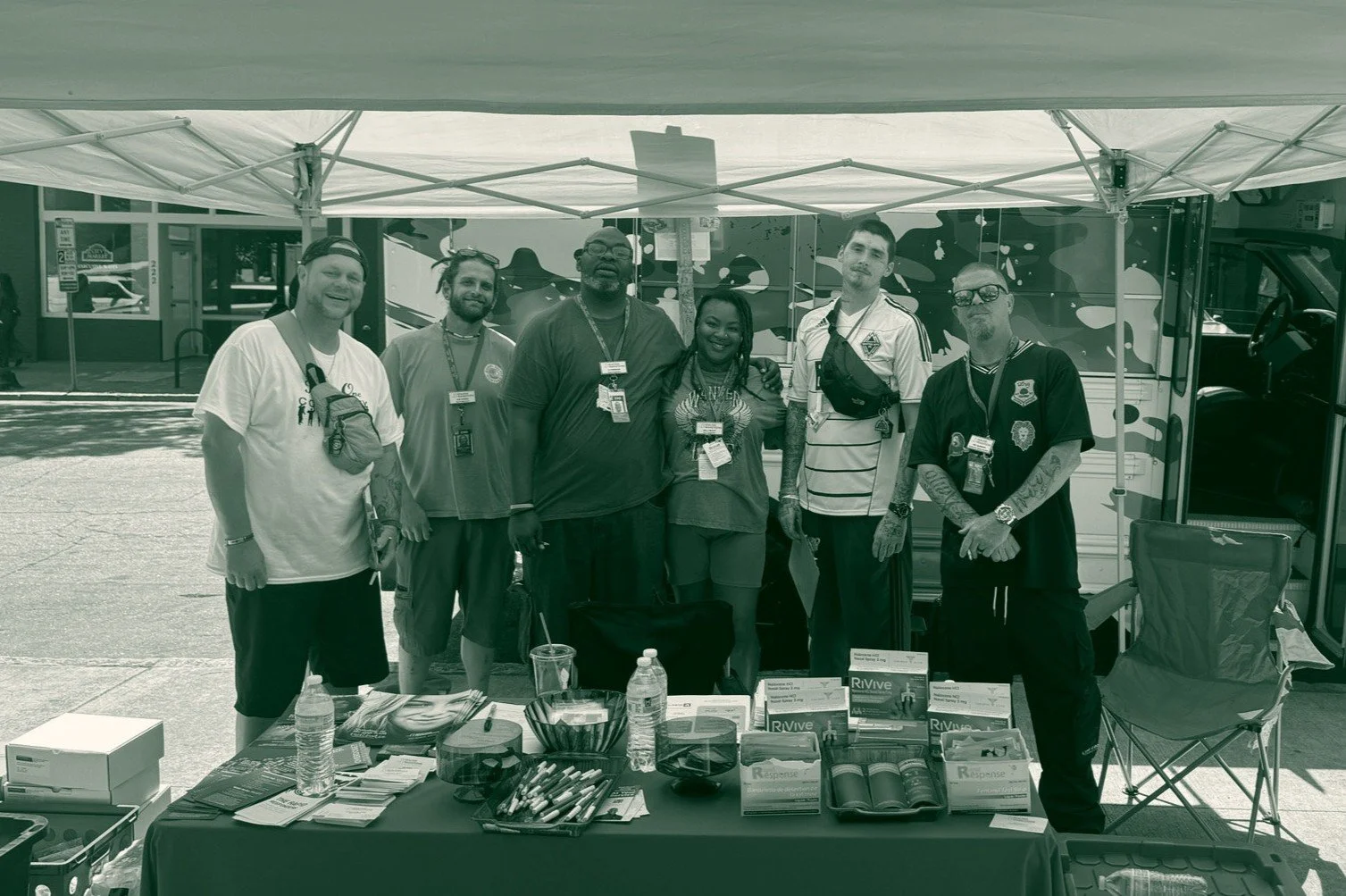
Healing Transitions built a peer-led, EMS-integrated continuum that connects overdose survivors to sustained recovery support across Wake County, pairing Certified Peer Support Specialists with Advanced Practice Paramedics for 24 to 72-hour post-overdose outreach and extending that relationship through syringe services, mobile MOUD, dedicated transportation, jail re-entry, and continuous engagement that does not end when someone relapses.
The Challenge They Were Addressing
Before Healing Transitions and Wake County EMS built this model, overdose survivors were receiving excellent emergency medical care and then being returned to the same conditions that had almost killed them. The systems designed to help existed, but operated in isolation from one another. Overdose deaths and repeat EMS calls to the same individuals were rising. Emergency departments stabilized patients and discharged them within hours with no follow-up plan. Paramedics administered naloxone, reversed overdoses, and left, with no mechanism to connect survivors to care. Individuals cycled through overdose, emergency detox, incarceration, and homelessness without ever accessing sustained support.
Advanced Practice Paramedics were repeatedly responding to the same individuals with nothing to offer beyond the naloxone in their kits, and they were openly frustrated. The frustration came from caring: paramedics had no resources to do more than reverse an overdose, so seeing the same person again left them asking, "Are we doing the right thing?" That question, voiced at a 2015 conference in Greenville and again as the Wake County Drug Overdose Prevention Coalition got underway, became the inflection point. EMS had real-time overdose data and field presence. Healing Transitions had peer relationships and operational infrastructure. Together, the two groups began building what neither had alone: a bridge between the overdose event and long-term recovery.
The gap was clear. Individuals were surviving the overdose event medically, but still dying in the system afterward. No single organization owned continuity of care. When Chris Budnick and a former APP co-chaired what was then the Coalition's Linkage to Treatment subcommittee, the first thing they did was rename it the Recovery Initiation and Maintenance subcommittee. The rename was deliberate. The goal was never to get people into treatment, but to help people initiate and sustain recovery, which may or may not involve treatment.
What They Built
Healing Transitions built a peer-led overdose response ecosystem that runs on a single operational rhythm: each morning, the organization receives encrypted overdose data from Wake County EMS, identifying every overdose survivor from the previous 24 to 72 hours. Certified Peer Support Specialists (Rapid Responders) enter the survivor information into the FiveCRM longitudinal database and coordinate the day's outreach priorities with Advanced Practice Paramedics. The APP and Peer Support Specialist conduct follow-up outreach to individuals who have experienced a documented overdose, typically within 24-48 hours. Together, they provide immediate support, assess needs, offer resources, and help connect individuals to available services and treatment options.
Following the initial outreach, the Peer Support Specialist remains engaged with the individual, continuing to meet them where they are, whether in encampments, motels, on street corners, in neighborhoods, at shelters, in treatment settings, or throughout the community. Through ongoing relationship-building, peer support, transportation, care coordination, and recovery navigation, they walk alongside individuals, providing consistency, encouragement, and connection long after the overdose event.
If the individual is ready for treatment, the Rapid Responder assists with detox placement, linkage to residential treatment, outpatient coordination, access to MOUD, recovery housing, and transportation. The 78.97 percent referral completion rate reflects peer-escorted navigation rather than a handed-off referral. If the individual is not yet ready for treatment, engagement continues actively through syringe services, overdose prevention education, wound care, HIV and STD prevention, and continuous outreach. Outreach does not end because someone relapses, misses appointments, returns to incarceration, or refuses treatment. In 2025, the team logged 1,746 six-month treatment adherence follow-up contacts. Relapse increases engagement; it does not end it.
Surrounding the post-overdose response is a full continuum operating simultaneously. Wake County Public Health embeds a nurse for weekly field-based HIV and STD testing and linkage to medical care. Morse Clinics operates a mobile MOUD clinic on the Men's campus (60 participants per day) and the Women's campus (30 participants per day), serving community members alongside residents. Dedicated MOUD transportation drivers run routes seven days a week to Morse Clinics, SouthLight MAT, and other providers, removing one of the most underestimated barriers to MOUD access. Jail in-reach and re-entry coordination extends the relationship into the post-release window. Men's and Women's Response Teams carry peer-led overdose prevention education back into the residential programs themselves.
Key Program Components
Who You Need at the Table
What made a willing partner essential vs. optional?
The model cannot operate without the EMS data pipeline, public health clinical capacity, on-campus MOUD access, and county-level behavioral health coordination. Each required partner solves a specific structural problem: EMS provides real-time visibility into who just overdosed and where; Wake County Public Health brings clinical legitimacy into community settings rather than expecting high-risk individuals to find their own way through systems; Morse Clinics eliminates the transportation and access barriers that make treatment theoretically available but practically unreachable; and Alliance Health anchors billing infrastructure and multi-year funding.
Helpful partners expand choice and capacity, but the four required partners define whether the model functions at all. The single hardest partnership to establish, and the most important, was the EMS data-sharing arrangement. The breakthrough was demonstrating that Healing Transitions was solving EMS's problem (repeat calls with no pathway forward), not just asking for their data.
Budget Breakdown
What is the minimum viable budget to replicate this?
The minimum viable staffing model for replication is one Certified Peer Support Specialist with lived experience, one EMS data-sharing agreement, and one organization committed to continuous engagement. With approximately $75,000, a small county can fund one full-time CPSS at $23 per hour with fringe, a basic case management or CRM platform, an EMS data MOU and legal review, a naloxone and supplies starter kit, transportation assistance through gas cards or mileage reimbursement, and CPSS certification support.
Everything else grows from demonstrated outcomes. Healing Transitions itself started with two peer responders and a small grant; the $1.2 million ecosystem is the result of ten years of building on what worked.
What Worked and Why
Specific decisions or design features that drove success
Pairing peers with APPs rather than running parallel but separate systems was the single most important design decision. The combined credibility of a medic and a peer in the same vehicle is greater than the sum of its parts. Medical credibility opens the door; lived experience keeps the relationship alive past the first encounter.
Treating transportation as treatment retention infrastructure rather than logistics changed what was operationally possible. Seven-day MOUD transportation eliminated the most common barrier to methadone retention for unsheltered participants who could not reach early-morning dosing windows on their own. Many counties underinvest in transportation; Healing Transitions learned that without it, treatment access is theoretical.
Bringing the MOUD clinic to the campus rather than sending people to treatment transformed access from aspirational to operational. The Morse Mobile Clinic partnership now serves approximately 90 residential participants per day across both campuses, as well as community members, without requiring anyone to travel, navigate stigma in a clinical waiting room, or arrange early-morning rides. There were 240 + individuals served in the first six months of the Morse Mobile Clinic at Healing Transitions.
Investing in FiveCRM early made outcomes visible, enabled coordination, and made the case for continued funding defensible. In the early years, tracking was informal, leaving the program unable to show what it was doing. Data infrastructure should be in place before the first client is served, not added after the program is operating.
Maintaining engagement after relapse meant individuals could re-enter care without losing the relationship or starting over with new systems. Healing Transitions stopped forcing people to choose between being alive and being accepted, integrating overdose prevention services and recovery into one continuum rather than treating them as separate worlds.
Early outcomes and data
1,803 unique participants served in 2025; 881 unique participants in the first five months of 2026
5,268 participant contact events in 2025; 2,400+ contacts in the first five months of 2026
78.97% referral completion rate and 81.16% client linkage rate within the Rapid Responders program
1,746 six-month treatment adherence follow-up contacts in 2025
4,043+ naloxone kits and doses distributed in 2025
192.79 lbs (~24,481 syringes) safely collected in 2025; an estimated 56 HIV cases potentially prevented
Mobile MOUD clinic serving ~60 participants/day on the Men's campus and ~30/day on the Women's campus, plus community members
275 unique MOUD referrals across Morse Clinics, SouthLight MAT, and other providers in 2025
Lessons Learned
Relationships, not systems, drive recovery. Every design decision in the model is built around the premise that people do not recover through systems alone. They recover through relationships. The peer is the relationship; everything else is the infrastructure that supports it.
Relapse must increase engagement, not end it. Organizations that discharge participants for relapse or non-compliance cannot operate this model. The moment of greatest vulnerability is exactly when the relationship must remain intact. This is an organizational philosophy, not a program feature.
Data infrastructure is not optional. Peer support programs fail nationally because they cannot document impact. A CRM or case-management platform must be in place from day one, even if it is a basic tool. Outcomes that are not tracked do not exist to a funder.
Build dedicated transportation capacity from the start. Without dedicated transportation capacity in Year 1, MOUD access is theoretical for the highest-risk participants. Build it in from the start rather than adding it later.
Formalize partnerships earlier than it feels necessary. The EMS relationship existed informally before written MOUs and data-sharing agreements were put in place. That gap created institutional vulnerability when key personnel changed. Get the paperwork done before you need it.
Grow peer specialists from within. The most effective Rapid Responders often came from within the residential programs. Formalizing a career pathway from participant to peer specialist to team lead from the start would have accelerated workforce development by years.
Amanda Blue, MSW, LCSW, LCAS, Dir. of Program Operations
Amy Brucia, Dir. of Recovery Support Services