EMPOWERED: Care From Pregnancy to Two Years Postpartum
A Peer-Led Wraparound Model for Mothers with Opioid Use Disorder

EMPOWERED provides comprehensive care coordination, peer support, counseling services, and stage-based health education for pregnant and postpartum individuals with opioid use disorder (OUD). Operated by Roseman University of Health Sciences, the program has maintained continuous operations since 2018, with full service delivery and outcomes tracking since January 2022. It is a no-wrong-door, no-barrier program whose purpose is to develop and unleash the power of expectant and recent mothers to manage their health and partner in their care: from recovery, through stabilization, to resilience.
EMPOWERED is certified by the State of Nevada's Substance Abuse Prevention and Treatment Agency (SAPTA) under NRS 458/NAC 458, the only SAPTA-certified program in Nevada providing comprehensive care coordination specifically for pregnant and postpartum individuals with OUD. The program is recognized at the state and federal levels as an emerging best practice for the depth of its evidence base and its ability to serve more clients without losing quality. It was one of the Fund for a Resilient Nevada's four original opioid settlement grantees, and one of only six programs selected nationally for SAMHSA's Pregnant and Postpartum Women Pilot program.
The Challenge They Were Addressing
EMPOWERED grew out of a pattern its co-founder, Andria Peterson, PharmD, saw firsthand through twelve years as a clinical pharmacist in the pediatric and newborn intensive care units at St. Rose Dominican Hospital. By 2015, half the babies in the NICU were experiencing neonatal abstinence syndrome (NAS), the withdrawal that can follow opioid exposure during pregnancy. Lengths of stay for these infants ran long, separation of mother and infant after discharge was common, and the same families returned with subsequent pregnancies. When a mother in labor was turned away because no NICU bed was available, the crisis inside the unit revealed itself as the visible symptom of a larger, unaddressed condition: opioid use during pregnancy and the months that follow, in a system with no coordinated response to it.
The population is a designated priority under federal regulation and Nevada statute; the services were not in place. Individuals with substance use during pregnancy are a priority population under 45 C.F.R. § 96.131 and NRS 458.103, and Nevada's opioid settlement framework (NRS 433.722) explicitly names "persons who are pregnant" as a special population for opioid abatement expenditure. Yet when EMPOWERED launched, no program in Nevada provided comprehensive care coordination for this population, and no comparable program exists in the state today.
The need was, and remains, severe and well-documented. Nevada's maternal mortality review committee found that the leading cause of pregnancy-associated death in the state was overdose, by a wide margin, across urban, suburban, rural, and frontier counties alike, and national figures point the same direction for people of reproductive age. The risk does not end at delivery: overdose risk peaks in the postpartum period, roughly six weeks through the first year, when hormonal change, stress, and return to prior use levels converge, precisely when standard obstetric care ends at the six-week visit. A recent statewide assessment (Advancing Perinatal Behavioral Healthcare in Nevada, 2025) confirms that specialty perinatal behavioral health care remains "limited and difficult to locate statewide," with 55 pregnancy-associated deaths recorded in 2022–2023. At least 12% of infants born in Nevada are gestationally exposed to substances, 65.3% of substance-exposed infants leave Nevada hospitals without a CARA Plan of Safe Care or child-protective notification, and the recurrence rate of substance use in future pregnancies is 70%. Separation compounds that recurrence: mothers who used substances during pregnancy are more frequently separated from their newborns at birth (an added trauma), and those separated are twice as likely to have substance exposure in a subsequent birth. The women in those numbers are the women EMPOWERED serves.
Screening and referral capacity had not kept pace. Many obstetric and clinical providers were not routinely screening pregnant patients for opioid use, unsure which medications were appropriate during pregnancy, and unsure where to send a patient who screened positive. Screening among pregnant Medicaid recipients in Nevada has risen from 0.1% in 2018 to just 7.4% in 2024, meaning the vast majority are still never screened. Patients had their own reasons to remain unseen. Stigma, unfair treatment, and fear of legal repercussions kept many from seeking prenatal care and treatment at all. The same clients were often without stable housing, transportation, identification documents, or income, and were frequently involved with child welfare and the criminal justice system. Without a referral pathway and a guide through it, clinicians and patients were both left without a next step.
What They Built
EMPOWERED Care Model
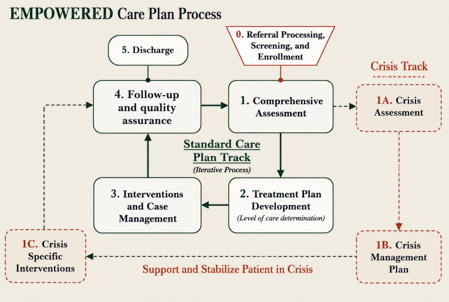
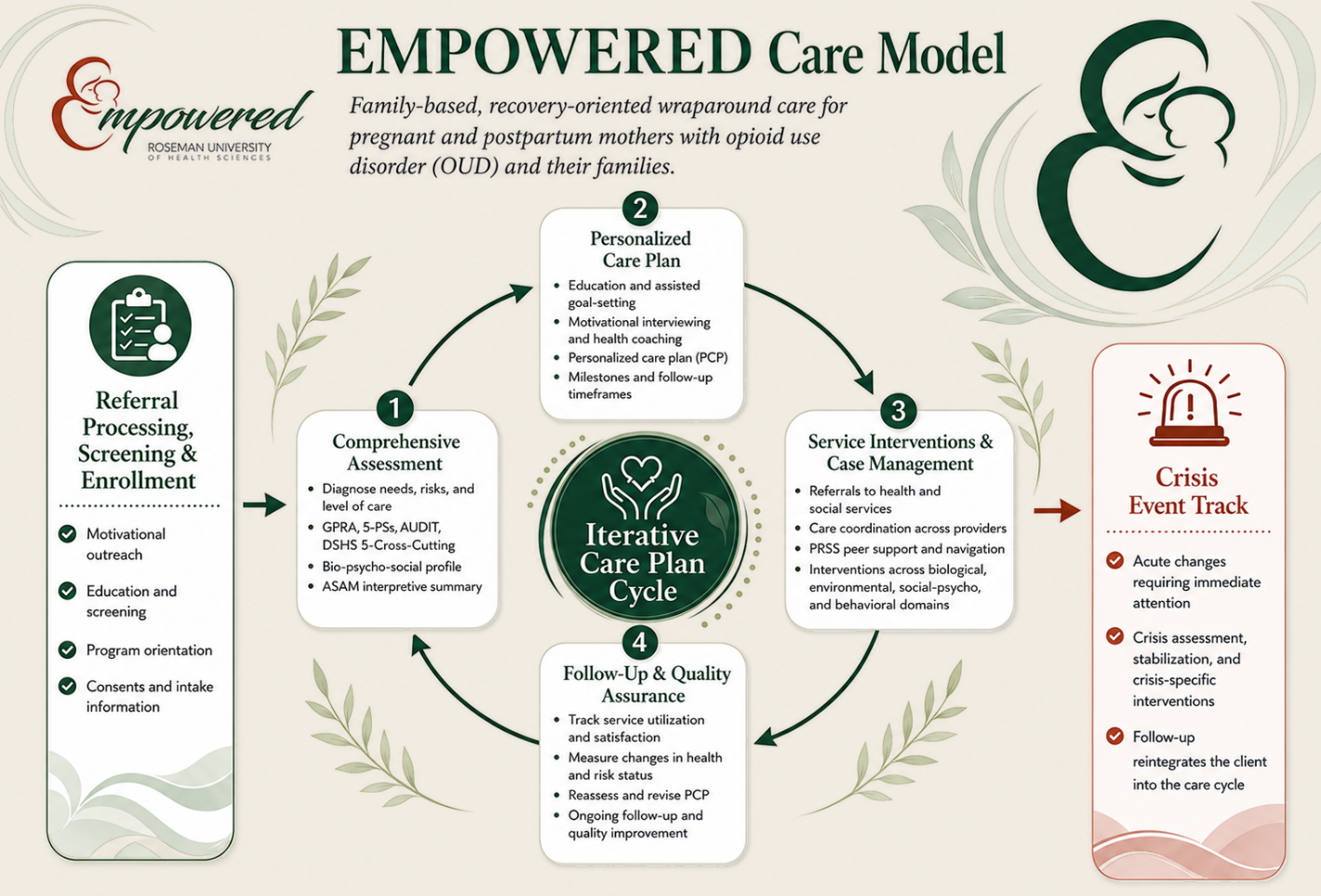
EMPOWERED delivers services through a four-step, iterative care plan process, initiated by referral processing, screening, and enrollment. (1) Comprehensive assessment, using validated substance use and behavioral health measures (including the 5Ps Screening Tool, AUDIT, and DSM-5 Cross Cutting), integrated into a composite health and risk assessment that yields a tailored biopsychosocial profile, an ASAM Interpretive Summary, and a risk stratification and level-of-care determination for each client. (2) Personalized care plan development, in which clients engage in assisted goal-setting modeled on health coaching and motivational interviewing, producing individualized recovery goals, service mapping, and milestone benchmarks. (3) Service interventions and case management, matching the full range of promotion, prevention, diagnostic, and treatment interventions to each client's actionable needs through direct referrals, care coordination, peer support, and navigation across medical, behavioral health, and social services. (4) Follow-up and quality assurance, measuring service utilization, client satisfaction, and changes in health and risk status, and feeding directly back into reassessment, plan revision, and recalibrated interventions. The program also maintains a dedicated crisis track: crisis events receive their own assessment, planning, and stabilization sequence, and clients are reintegrated into the standard care plan process rather than discharged. This care plan cycle is technology-supported and used to connect and align clients, providers, and community partners across the continuum of care. Trauma-informed care is a universal stance that guides every interaction within that care model, and all staff are trained to accompany clients at every step.
Program Structure
Every enrolled client receives the program's Core Services (case management, care coordination, resource referrals, patient navigation, and peer support groups) delivered to every client at every stage. Individualized Services are tailored to each client's needs in both content and dosage: individual counseling and therapy, group therapy, individual peer support sessions, peer accompaniment, provision for critical needs such as baby supplies and food, and transportation support.
Layered onto these are Stage-Based Services, Peer-Based Social & Recreational Support, and Health Education that are organized across three perinatal stages, forming a developmental arc that can be tailored to any specific case. The pregnancy stage focuses on prenatal care and treatment for stabilization, health, overdose protection, and NAS mitigation. The 0–12 months postpartum stage focuses on addressing barriers and triggers, overdose protection through the highest-risk months, parenting skills, and retaining recovery for long-term health and growth. The 12–24 months postpartum stage focuses on building resiliency, ongoing social supports, life skills, and self-empowerment. Each stage carries its own peer support groups, health education classes, and Pathway to Renewal (contingency-management program) that reinforces recovery-goal behaviors that earn credit toward supports that fit the client's stage. Monthly Sober Socials pair substance-free community with practical health education. Gatherings have ranged from "Recovery Bingo" and "Power of Your Story" to "Infant Oral Health" and "Pregnancy Yoga." Participation follows a graduated posture across the stage-based arc: encouraged during pregnancy, strongly recommended in the first postpartum year, and attended by second-year clients as "buddies" to the newest, a mentorship function the stage structure produces without additional staffing. Delivery by stage also forms natural cohorts (clients at the same point in the perinatal arc), which increases the relevance of peer-to-peer experience and deepens supportive relationships.
Stage-based health education is delivered through the EMPOWERED Life Series (eds. Peterson & Stefano), the leading maternal recovery health education curriculum in the United States and the only known published curriculum to integrate stage-based recovery progression, perinatal health education, and the practical conditions that shape health (housing, transportation, identification documents, income) as a workbook series designed for pregnant and postpartum women in recovery. Spanning nine volumes and more than thirty evidence-based workbooks produced through Health Copilot AI's precision health education pipeline, the series guides clients from crisis to coping to thriving across the full perinatal journey. Three strands run structurally constant through every stage (Recovery, Health, and Resilience; Healthy Mother; and Healthy Baby, Healthy Family), so the same three concerns travel with the client as her stage and situation change. Completion accumulates into stackable certificates (Healthy Mom; Healthy Home, Healthy Baby; Healthy Family, Resilient Life), resolving into the EMPOWERED Life certificate. Because each certificate marks completion of specific course requirements, the credentials also travel: clients and staff use them to communicate progress to the systems where documented momentum matters (the Department of Family Services, the Division of Welfare and Supportive Services, and the criminal justice system). The curriculum integrates the evidence-based practices the program is recognized for: Medications for Opioid Use Disorder (MOUD), Cognitive Behavioral Therapy, Motivational Interviewing, Trauma-Informed Care, Contingency Management, Circle of Security Parenting, and SBIRT.
Personnel Structure
A multidisciplinary team delivers the model, each role defined by the part of the care plan process it supports.
Program leadership and administration guide the entire program across both of its arms, Empowering Clients and Empowering Communities: program oversight, quality assurance, and the reporting that settlement funding requires; oversight of clinical staff; and the community engagement and partnership cultivation described under Key Partners. Leadership also stays in the room with clients, leading some of the group therapy sessions and supporting direct services.
Care managers take each client through that process from end to end (from referral processing and screening through level-of-care determination and the personalized care plan, to patient navigation, services, and follow-up) and coordinate the program's social work across the medical, behavioral health, and social services each plan calls for.
Therapists (licensed clinical social workers) provide individual therapy and lead the weekly groups, addressing substance use, mental health, and overall wellness as one clinical picture, and a supervising psychiatrist oversees the behavioral health services, holding them to clinical best practice and providing oversight for the program's crisis protocols.
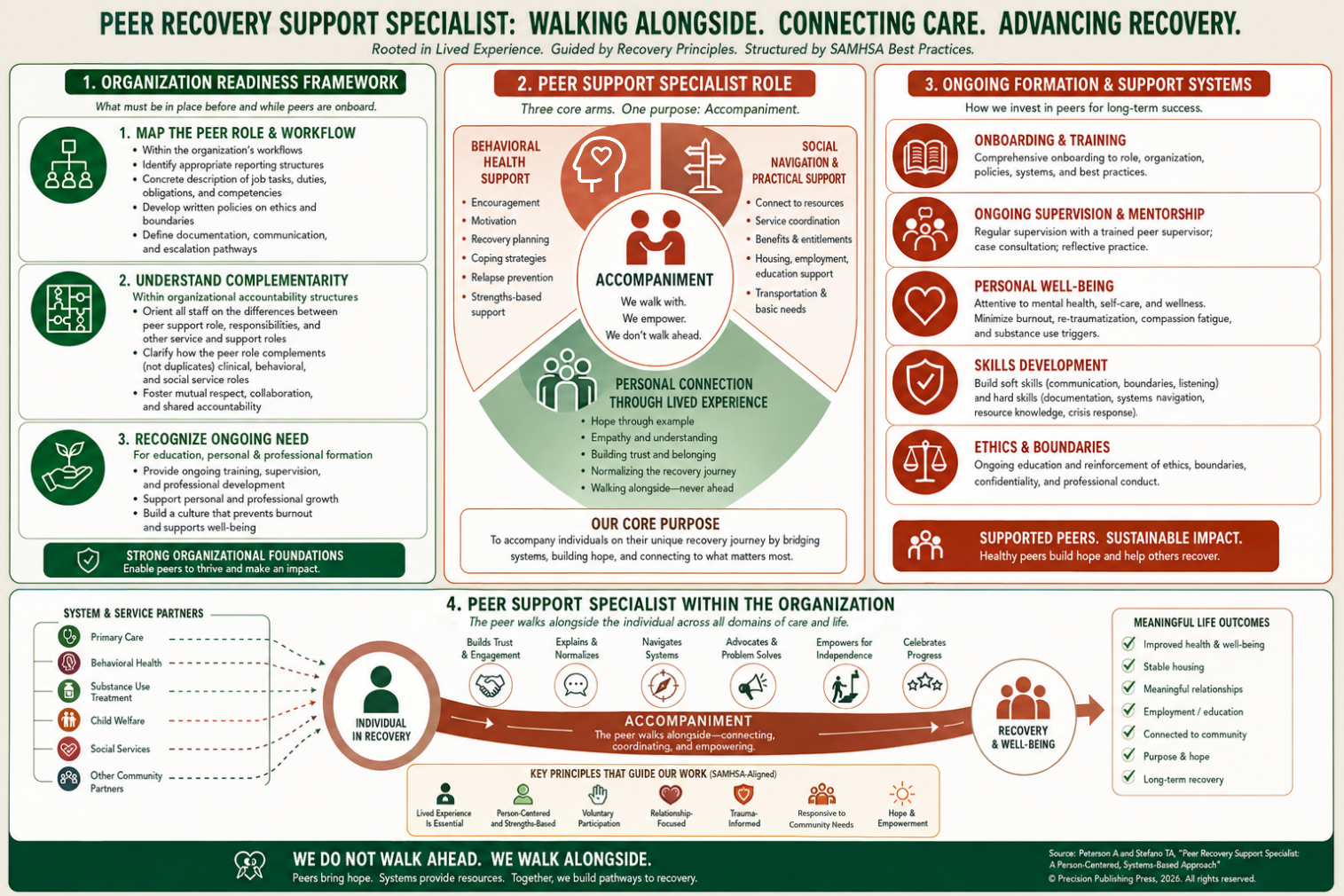
Certified Peer Recovery Support Specialists provide peer support and accompaniment that goes where the client goes (one-on-one sessions, home visitation, and field support and care navigation across the settings her life runs through: her home, community organizations, clinical providers). Lived experience deepens accompaniment into personal connection: empathy and understanding, trust and acceptance, a normalized recovery journey, and hope through example.
Program evaluation personnel (an evaluation lead and a data scientist, each part time) oversee data collection, evaluation, and quality improvement, converting data into information and information into actionable insights, allowing the program to maintain compliance, reporting, quality assurance, and quality improvement.
Integrated Care Intelligence
The program's operations and services are supported and enhanced through Health Copilot AI's integrated, AI-native care intelligence platform, CareOrb AI, that automates social risk and health assessments, delivers personalized care plans and support, enhances care coordination, optimizes and manages referrals, and provides real-time analytics and reporting. For the client, the platform takes the form of a personalized mobile companion (My Health Copilot AI) that turns her care plan into accessible, actionable steps and delivers education and support between formal encounters. Her care team works from a connected workspace (Social Risk Navigator AI) that keeps the client, her plan, and her progress in sync in real time, with referrals drawn from a continuously discovered and verified picture of the community's services (ReferralFlow AI), so support reaches her while motivation is highest. At the program level, reporting, dashboards, and analytics are automated (ReportStream AI), so quality assurance, compliance, and funder transparency are built into the work as it happens rather than reassembled afterward. The effect is to hold the program's defining structure and care approach steady at any size: integrated care delivery that serves more clients while maintaining the personalized, high-quality support that defines the EMPOWERED approach. (EMPOWERED and CareOrb AI: Scaling care without losing what makes it work)
Community Referral, Service, and Support Infrastructure
Alongside its services, EMPOWERED built the community infrastructure that those services depend on: years of outreach, engagement, and partnership cultivation that have woven the community organizations that partner with the program into a connected ecology of referral, service, and support. The relationships this work produces are seldom one thing. A single partner may screen and refer pregnant and postpartum individuals into the program; receive clients the team navigates to it, with each referral defined by the client's care plan; contribute support in the form of resources, services, relationship capital, or infrastructure; and/or work alongside the program to build capacity, awareness, and alignment across the community's organizations. A hospital can hold all of these roles at once: screening and referring from labor and delivery, receiving navigated clients in its clinics, hosting the program's case for universal screening in its councils. For the client, that depth is the difference between a referral and a connection: the receiving organization knows the program, she arrives prepared and often accompanied, and what happens there is reflected in her care plan. The network this work has built is profiled under Key Partners.
The care plan process is the common workflow through which every service is assessed, assigned, and verified. The stage-based architecture keeps every service timely (matched to where the client actually is) and surrounds her with peers who accompany her in her care journey. The team brings together clinical care, social care, and lived experience around the same client, each supporting and coordinating a personalized, holistic care experience. The intelligence layer keeps the client and her care team in sync and runs personalization and quality controls across the full caseload. The program's community partners form a network that transforms referrals into care connections. The program is family-based, recovery-oriented, fully voluntary, and provided at no cost to clients, down to the office itself: a suite on the Summerlin Campus of Roseman University, set up with dedicated spaces for children, so clients can bring their infants and toddlers rather than miss appointments for lack of child care.
Key Program Components

Who You Need at the Table
EMPOWERED's services run on two arms that feed each other. Empowering Clients is the direct-service arm: the care plan process and everything delivered through it. Empowering Communities is the community-facing arm: outreach and engagement that raise awareness among providers and potential clients; capacity-building and alignment that map the community's social care assets and organize them to work in concert; and promotion of evidence-based practices and policies (universal screening, SBIRT adoption, referral pathway development) across the continuum of care.
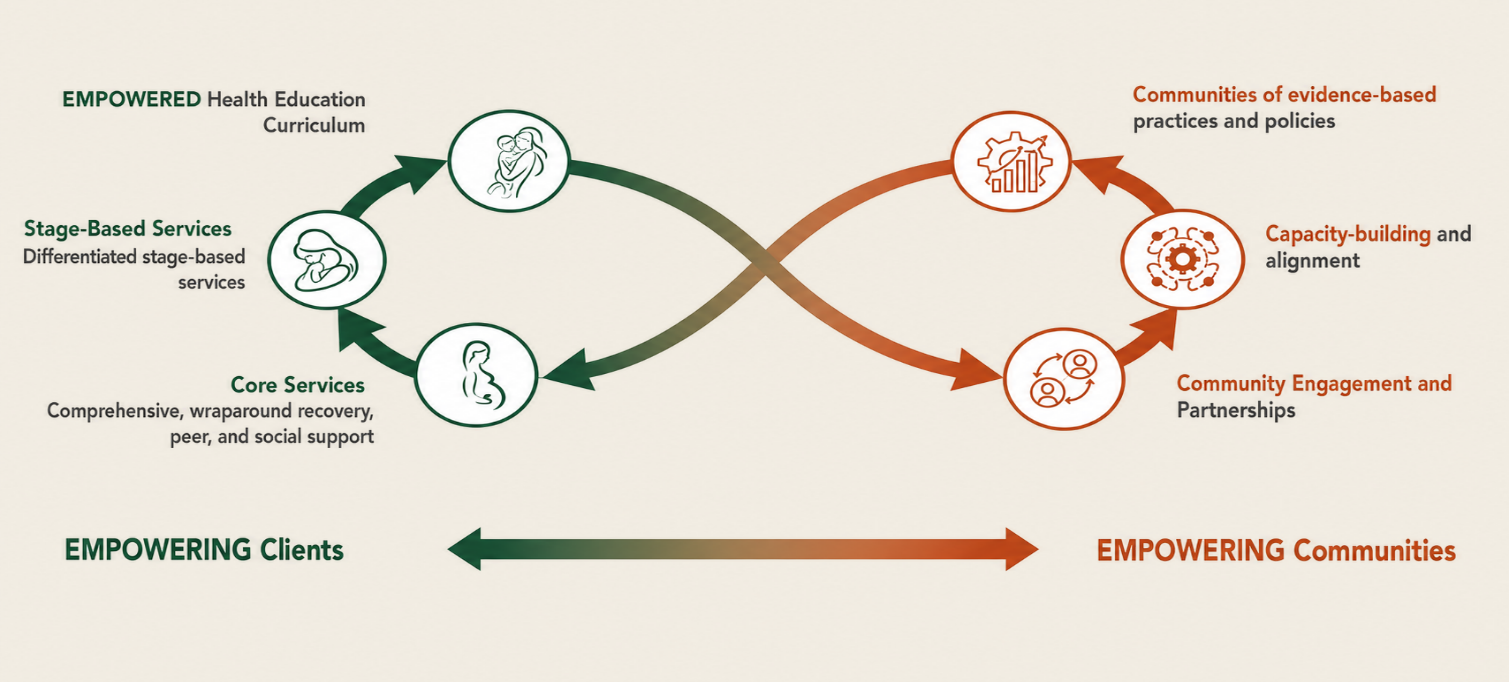
Both arms run through the same network: a care coordination hub of 155+ community partners (hospitals, obstetric and clinical providers, behavioral health providers, child welfare agencies, courts, community-based organizations, educational institutions, and social service organizations) with bidirectional referral pathways built over eight years of continuous operation, and alignment. EMPOWERED personnel extend the Empowering Communities arm to the policy level, serving on the Nevada Patient Protection Commission (to which Executive Director Andria Peterson was appointed by the Governor), the Nevada Perinatal Health Initiative, the Maternal Mortality Review Committee, the Congenital Syphilis Review Board, the Governor's Behavioral Health Planning and Advisory Council, and the Southern Nevada Opioid Advisory Council.
What made a willing partner core vs. complementary vs. optimizing?
EMPOWERED classifies its partnerships by their relationship to the care plan process. Core partnerships enable services, resources, or interactions intrinsic to the essential care workflows: screening, referral, funding, clinical infrastructure, and the child welfare interface where family decisions are made. Without them, the care plan process itself cannot run. Complementary partnerships enrich the ecology of services around the program: they widen reach, feed referrals and build capacity and alignment across the community. The program treats every one of those connections as worthwhile, because a single referral from an agency that meets this population only rarely can reach a person who would otherwise go without support. Optimizing partnerships are not required to deliver the core service to a single client; they are what make the same workflows run with quality, efficiency, and growing reach (essential for growth, sustainability, and quality assurance).
Budget Breakdown
What is the minimum viable budget to replicate this?
The minimum is a structure, not a figure. Whatever the client volume, the floor is the model's essential configuration: clinical social work running the care plan process, peer support funded to the full scope of the role, therapy within reach of every care plan (staffed directly or supported through braided funding), a budget for transportation and critical needs, and a budget for leadership/administration and evaluation roles. Screening runs inside partner clinical workflows, but that frequently requires initial and some ongoing spending on clinician education and marketing for program awareness. The published curriculum may now be adopted by other programs wishing to implement it. The intelligence layer runs under an enterprise master service agreement. Facilities and related operations depend on the program's embedded context and must be evaluated against indirect cost rates. With this approach, the budget grows with the number of clients served, while the structure stays whole at any size.
What Worked and Why
Within the program: the design decisions
Integration through the care model. Every service the program delivers (clinical, peer, educational) enters through assessment, is assigned through a personalized plan, and is verified through follow-up. What makes this effective is that the elements support one another instead of operating as parallel programs: the social worker's assessment directs the peer's navigation, what the peer sees in the field returns to the next follow-up, and education is assigned from the care plan rather than from a fixed calendar. For clients whose recovery, health, parenting, and system involvement form one interconnected situation, integrated support is what produces holistic recovery, and the outcome data below point in exactly that direction.
Clinical social work aimed at social risk and behavioral health. The program put a licensed clinical social worker at the center of the workflow because the barriers that undo this population's recovery are predominantly social and behavioral: housing, transportation, income, safety, co-occurring mental health needs, child welfare involvement. Addressing social risk is not an adjunct to treatment; for this population it is the condition under which treatment can hold. Clients' measurable gains across SAMHSA's four dimensions of recovery reflect that priority.
Peer support grounded in lived experience. Certified Peer Recovery Support Specialists in long-term recovery engage clients whom clinical authority alone cannot reach: they normalize the journey, model that it can be completed, and hold the relationship through setbacks. Substantial evidence indicates that peer support helps people become and stay engaged in recovery and reduces the likelihood of relapse. EMPOWERED then funded the role at the top of its scope (home visitation, community accompaniment, and navigation alongside one-on-one sessions), so the peer is present at the moment a plan turns into action: the first prenatal visit, or the DMV trip too intimidating to face alone. The commitment shows in a single reporting period's counts: 173 navigation sessions, 32 offsite accompaniments, 63 home visits.
Stage-based structure. A pregnant client stabilizing on MOUD, a new mother navigating triggers and parenting, and a second-year client building employment and long-term supports need different services, different education, and different peers around them. Organizing the program by perinatal stage matches every intervention to the developmental moment it serves and puts each client among peers at the same point in the arc. Classes and groups stay relevant across two years instead of repeating, and clients progress rather than cycle. The curriculum's pedagogy follows the same arc: it anchors new material in what a client already knows and has lived, builds toward greater complexity, and returns to integrate at a deeper level as her stage changes.
Intelligence that keeps care personal as the caseload grows. For a relationship-based program, growth is usually where quality dies: every new client adds assessment, planning, coordination, documentation, and follow-up time, so reach stays bound to headcount, and expansion either compounds cost or dilutes exactly the relational intensity the model depends on. The program's answer is its intelligence layer. CareOrb AI absorbs the non-relational work (documentation, reporting, administrative coordination) while enhancing the relational work of keeping the care team coordinated, copiloting the care plan process, and carrying support into the hours between encounters. The program grows by extending person-centered care, not by trading it away.
Beyond the program: building the system around it
Advancing universal screening statewide. No program can serve clients it never receives, and identification is the rate-limiting step for every downstream service. Working with the state health committee and Medicaid, the team helped advance universal screening, brief intervention, and referral to treatment (including a continuing education requirement for licensed clinicians statewide), so that more pregnant patients are identified and connected to care early. Adoption is won institution by institution: the program tours maternal-child units, presents to labor-and-delivery councils, and works to cultivate physician champions for screening.
Deliberate capacity-building and partnership. A care coordination program is only as strong as the services it can coordinate. The partner network described under Key Partners was built deliberately (mapping the community's social care assets, aligning them to work in concert, and keeping even one-referral-a-year relationships warm), and it is why the program's referrals land and why partners send clients back.
Raising awareness among potential clients, family members, partners, and providers. For a population that lives with stigma and fear, and has learned to find safety in invisibility, awareness and a community sense of trust are the preconditions of access: a client cannot seek a program she has never heard of, and will not seek one she does not trust. EMPOWERED builds that visibility and trust deliberately: awareness media campaigns; a podcast series that speaks to patients, to family members learning to understand and support a mother in recovery, and to providers learning how to recognize, support, and navigate patients with OUD; partnership with community organizations that serve as ambassadors of trust; and the third-party credibility that public recognition and awards carry into the community. That outreach is why many clients reach the program by self-referral: they arrive already knowing what it is, and already trusting it.
Early outcomes and data
Since January 2022, EMPOWERED has delivered more than 2,100 case management sessions, nearly 2,000 individualized peer support sessions, and close to 1,500 targeted referrals, serving 562 unduplicated clients across a high-need, high-touch population. The outcomes register across SAMHSA's four dimensions of recovery (health, home, purpose, and community), the same dimensions every component of the program is built to serve.
Among members enrolled with participating managed care organizations:
OB office visits rose 10.2%, and fetal stress tests increased 20-fold: greater engagement in prenatal care
OB inpatient and antepartum services outside of delivery decreased 66%
Emergency room visit acuity decreased 21.9%: fewer catastrophic presentations
Members seeking treatment increased 3,654%, and treatment compliance and frequency increased 39-fold
Mental health partial hospitalization decreased 96.9% while outpatient behavioral health visits increased 676%: a shift toward outpatient levels of care
These figures are managed care outcome data for enrolled members, reported as observed associations rather than causal proof of program effect. Their direction is consistent across every measure: earlier engagement, fewer crises, care delivered at lower-acuity settings. The economics point the same way. Untreated perinatal behavioral health conditions cost an estimated $42,000 per affected mother-infant dyad when substance-exposed infant costs are included, a composite of two peer-reviewed, non-overlapping cost estimates, one for the mother and one for the infant. EMPOWERED delivers comprehensive care coordination at approximately $7,750 per dyad. For every dollar invested, the program averts more than five dollars in downstream costs to Nevada's healthcare, child welfare, and criminal justice systems: at contracted capacity, an estimated $4.2 million a year.
The program and its leadership have been recognized with the Clark County Medical Society's Winged Heart Award, the Southern Nevada Health District's Public Health Hero Award, the Nevada Hospital Association's Imagination Award, and honorable mention for The Arnold P. Gold Foundation's Pearl Birnbaum Hurwitz Humanism in Healthcare Award.
Building a Program Like EMPOWERED
The question is not how to retrace EMPOWERED's history. It is what building a program like it from the ground up entails today, when the model, its lessons, and infrastructure that did not exist when EMPOWERED began are all available at the outset. Understood that way, the program consists of four structural dimensions. They are not phases of a timeline; they are the dimensions along which the program must be designed, and the dependencies among them are logical rather than chronological. The enabling ecology determines whether clients arrive and referrals land. The core program determines what clients receive. The intelligence infrastructure determines the efficiency and quality at which the core can run and grow. The accountability structure determines whether any of it is funded, audited, and renewed.
1. The enabling ecology: what surrounds the program and connects it to its clients. A care coordination program does not generate its own clients, and it does not deliver most of what its care plans call for. Four things outside the program enable it.
Community partnerships and capacity-building: mapping the community's existing social care assets, organizing them to work in concert, and building relationships with the organizations that will receive the program's referrals and send it their own.
Universal screening with clinician education: screening, brief intervention, and referral to treatment at every encounter, including delivery, identifies both parents and infants who need care, and clinicians screen when they know what to do with a positive result.
Awareness and policy: outreach toward potential clients, their families, and providers (the visibility and trust that make self-referral possible), and the policy work that makes screening expected and reimbursable.
Referral pipelines: bidirectional pathways with the hospitals, child welfare agencies, courts, shelters, and treatment programs that touch this population, including the CARA Plan of Safe Care interface with child welfare, where referrals often begin at delivery. EMPOWERED's mature form of this dimension is its Empowering Communities arm and 155+ partner network; at its smallest, it means enough screening and enough partnership that clients arrive and referrals land.
2. The core program: personnel, resources, services, workflows. The program itself consists of four kinds of elements, and the relation among them is the design: personnel and resources produce services; clients experience the services; the workflow integrates services, personnel, and partners into one program.
Personnel: care management capacity for referral processing, screening, and coordination; licensed clinical social work anchoring assessment, care planning, and therapy; and Certified Peer Recovery Support Specialists in long-term recovery, funded for the full scope of the role (office, home, and community) because the peer provides a connection a clinical credential cannot, and the field is where plans become actions.
Resources: a family-friendly space clients can bring their children to; a budget for transportation and critical needs; and a stage-based curriculum that is adopted, not authored. A curriculum built around a single subject-matter expert does not travel: EMPOWERED paid to develop facilitator guides, handouts, and standardized course content precisely so its classes could be delivered by program staff across settings, and the published EMPOWERED Life Series now exists so that the next program does not have to repeat that work to deliver its results.
Services: the service architecture rather than a service list: Core Services for every client, Individualized Services tailored in content and dosage, and Stage-Based Services, Peer-Based Social & Recreational Support, and Health Education organized by perinatal stage into cohorts.
Workflows: the four-step care plan process with its crisis track. This is the dimension replication most depends on: it is what makes personnel, resources, and services one program rather than co-located offerings. Adopt it whole, run it consistently, and document it as it runs.
3. The intelligence infrastructure. AI-native infrastructure, embedded from the beginning and configured to the intended workflows, shapes how those workflows run: assessment delivered as guided conversation, social-risk screening that adapts to the client's stage, service matching that converts identified needs into recommended interventions the moment they surface, client engagement that continues between encounters, referrals as tracked events to validated services, and reporting as an automated pipeline. This dimension is what enables a program to grow efficiently and sustainably, reach more clients, and be built on a structure that can carry a larger caseload from day one (see Integrated Care Intelligence, above).
4. The accountability structure: what makes the program fundable and durable. Fiscal policies and procedures rigorous enough for settlement-fund monitoring, established before any drawdown; statutory constraints understood in advance, such as Nevada's five percent administrative cap; and the confidentiality obligations of HIPAA and 42 CFR Part 2 designed into records practice before the first client record exists. State certification is pursued early (in Nevada, SAPTA certification under NRS 458/NAC 458). Outcomes measurement is designed against the care plan process's follow-up step, so evaluation is produced by the workflow rather than reconstructed from it. Relationships with Medicaid and managed care organizations for outcome data and eventual reimbursement mean, in practice, obtaining a National Provider Identifier, pursuing provider-type credentialing, and aligning services and staffing to meet reimbursement requirements. This dimension converts a good program into a funded, auditable, renewable one.
Lessons Learned
Let the clients' needs and outcomes set the support window. The extension to two years postpartum was not a planning assumption; it came from clients, whose needs kept presenting well into the second year. EMPOWERED reviews the length of support against what clients need and which support sustained recovery and resiliency.
Treat every referral relationship as worthwhile. Agencies that rarely encounter pregnant and postpartum individuals in recovery often do not know what to do when they do. Staying visible to a partner who sends one referral a year reaches a person who would otherwise be missed.
Be a careful steward of settlement funds. Understand the settlement rules (including statutory limits on administrative expense) and build rigorous fiscal policies before spending. Good stewardship protects the program and the larger fund, and it is what makes a funder relationship like the one EMPOWERED has with the Fund for a Resilient Nevada possible.
Seek funders who partner to fund iteration. EMPOWERED's greatest breakthroughs came when funders allowed the program to refine its approach through real-time quality-improvement feedback loops. Funders who understand that progress may include pivots, setbacks, and unexpected opportunities become partners in a community of solutions that creates space for genuine innovation.