AIM Team: After-Hours Peer Response
A Peer-Led, Overnight Model for Rapid Treatment Access
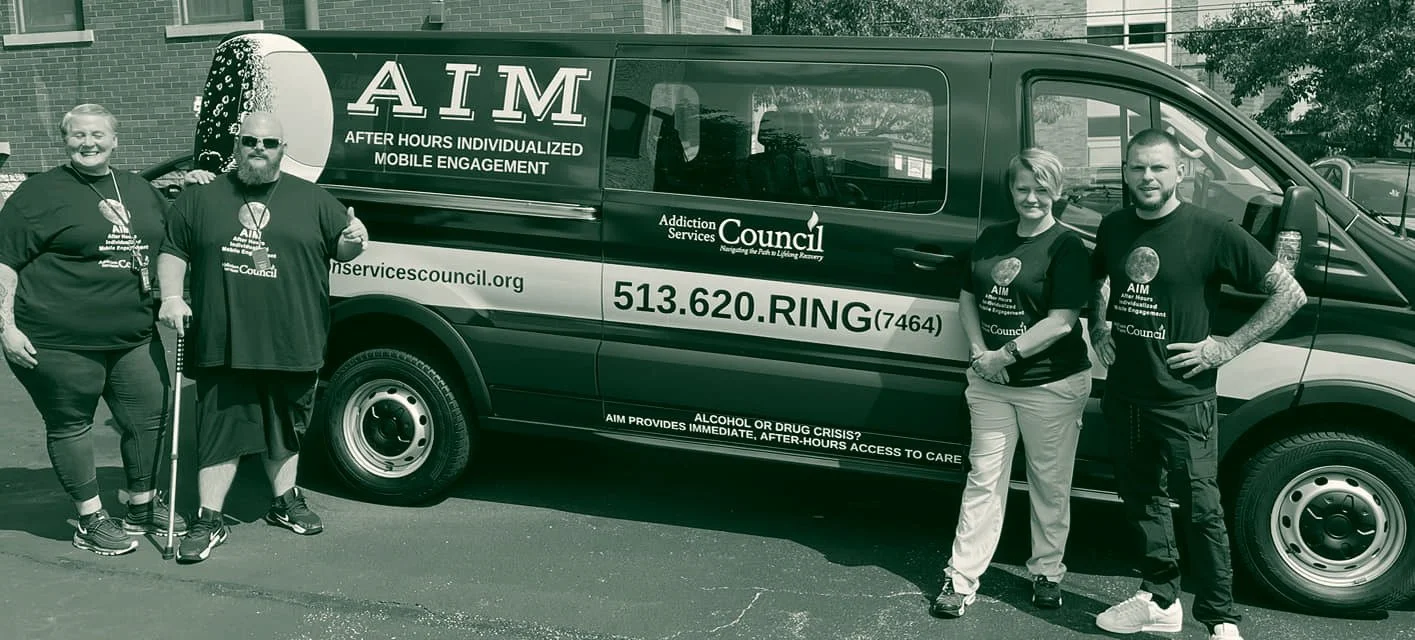
Addiction Services Council's AIM Team uses OneOhio opioid settlement funds to provide 8 p.m. to 8 a.m. peer response and direct transportation to treatment, so people seeking help after business hours can be met in person and connected to care immediately, in the short window when they are ready to act.
The Challenge They Were Addressing
In Hamilton County, the doors to treatment effectively closed by mid-afternoon. A person who reached out at 6 p.m., 10 p.m., or 2 a.m. asking for help would typically be told to call back the next morning, and the next morning, they often did not call. ASC staff sometimes recognized names on the local coroner's overnight report from people who had reached out the day before. The window in which someone is ready to ask for help is short, in ASC's experience, usually less than an hour, and the system was not open during those hours.
With no after-hours alternative, hospital emergency departments and first responders became the default response. They could stabilize a person in crisis, but they had no practical way to move that person from the ED bay or the curb into a treatment program in the middle of the night. Beds existed, but the connection to those beds did not. The same pattern repeated in the local jail, where ASC already operated a treatment program: people leaving custody overnight needed somewhere to go and someone to take them there.
Addiction Services Council, a Cincinnati-based nonprofit founded in 1949, had spent decades providing prevention, treatment, recovery support, and community outreach across hospitals, the justice system, and community settings. The agency could see the after-hours gap clearly because its daytime programs kept hitting it. The AIM Team was built to close that gap with a small, fast, peer-led response designed around one operating principle: when a person says yes, meet them in person and get them to treatment that night.
What They Built
AIM is a small, mobile, peer-staffed crisis response that operates from 8 p.m. to 8 a.m., 365 days a year. Two teams of two certified peer recovery specialists cover the overnight hours. Calls come in from hospital emergency departments, first responders, the local jail, individuals on the street, family members, and community partners. A cloud-based phone system lets peers answer and dispatch from anywhere in the service area, including from home if needed.
When a call comes in, the peer on shift conducts a brief safety screening, confirms what the caller is requesting, and, if an in-person response is requested, deploys to the location. The team typically arrives within about 30 minutes. If the call is from the street, two peers respond together. If the call is from a hospital or other facility, a single same-gender peer can respond, with a second peer joining for any transport. The encounter focuses on brief intervention, peer support, and immediate transportation to treatment. AIM does not currently conduct a full biopsychosocial assessment, and the service is not billed to insurance.
The product is a ride. When a person says they are ready, AIM drives them directly to a treatment program that has agreed to accept after-hours admissions, hands them off to the admitting clinician, and stays as long as needed to ensure the warm hand-off lands. If no immediate placement is available that night, AIM finds a safe place for the person to wait until morning while coordinating admission. Daytime ASC staff support the program by conducting outreach using AIM cards and building referral relationships with hospitals and first responder agencies.
Operational policy is tight and written. A consent script is read aloud at the start of every transport, and the person can end the transport at any time. Belongings are limited to what the person can carry in one trip. The team will only transport to treatment, not to a home, an errand, or any other destination. Vehicle safety is governed by an agency driver handbook, Bureau of Motor Vehicles (BMV) checks on all drivers, non-owned auto and vehicle insurance policies, regular maintenance checks on personal vehicles used in the program, an emergency kit, and a foundation-purchased agency van.
Key Program Components
Who You Need at the Table
What made a willing partner essential vs. optional?
A required partner is one without whom AIM cannot dispatch, transport, or admit. OneOhio funding is required because the service is not billable to insurance. A treatment provider willing to accept admissions in the middle of the night is required because that is the destination. Hospitals and first responders are required because many calls originate there. The local jail is required because people exiting custody overnight are one of the groups most ready to engage. A trained peer workforce is required because the work is peer work, and the encounter only succeeds when the responder is someone the person in crisis can trust.
Helpful partners expand reach and resilience without being essential to day-one operations. The foundation that purchased the agency van removed a major one-time expense. The Ohio Deflection Association connects AIM to similar models across the state. Daytime ASC outreach programs and the local mental health board create the daytime context that brings people to AIM's overnight door. State-level champions matter for the next stage, expanding the model to counties beyond Hamilton. None of those are required to answer the phone tonight, but each one strengthens the system around AIM.
Budget Breakdown
What is the minimum viable budget to replicate this?
At Hamilton County's size, AIM runs on about $500,000 over two years to cover four full-time peer responders, supervisor time, vehicle costs, insurance, phone system, and standard agency overhead. A leaner version of the same model is realistic. A rural county starting with $75,000 could pilot one or two trained peers covering limited overnight hours, on-call transport support rather than a dedicated van, a cloud-based phone line, one committed treatment admission partner, and a modest mileage and insurance allocation. The non-negotiable line items are people who can do the work, a phone that gets answered, a vehicle policy that is safe and insured, and a treatment partner who will open the door when AIM arrives.
What Worked and Why
Specific decisions or design features that drove success
Designing the program around the short window in which a person is ready to act is what makes the model work. AIM does not collect insurance information at the door, does not conduct a full clinical assessment on the spot, and does not schedule the person for a next-day appointment. The peer on the phone confirms the person is ready, dispatches, and drives. The simplicity is in the design.
Staffing with peers who are comfortable in overnight community settings, not only in office settings, is the second decision that drives outcomes. The team meets people on sidewalks, in hospital lobbies, in jail discharge areas, and in housing of every kind. People who do this work well are people who can hold a steady, non-judgmental presence at 3 a.m. in places that are not always easy. ASC hires and trains those who fit explicitly, in addition to standard peer credentials.
Locking down operational policy early and sticking to it has kept the program safe and trusted. The consent script at the start of every transport, the rule that the person can end the transport at any time, the one-trip belongings limit, and the rule that the vehicle goes only to treatment are all small choices that, taken together, keep peers and clients safe and keep the program defensible. The vehicle insurance, BMV checks, and driver handbook were built before the first transport, not after.
OneOhio settlement funding stabilized a program that the daytime system has come to depend on. The service is not billable to Medicaid or private insurance, so without dedicated non-billable funding, AIM would not exist. Settlement dollars, in this case, are paying for an after-hours layer that hospitals, first responders, and the jail are now actively routing people into.
Embedding AIM inside ASC, an agency with deep daytime relationships across hospitals, the justice system, and the community, compressed the time to credibility. Hospital ED leadership and first responder agencies already knew ASC. The AIM phone number was a new entry point on top of an existing relationship, not a cold call.
Early outcomes and data
2025 overnight AIM Team activity (services sustained by OneOhio funding): 328 crisis calls answered, 314 in-person responses requested (96% of calls), 215 individuals transported directly to treatment (68% of in-person responses).
From 2022 through 2025, 53% of all callers were transported directly to treatment.
From 2022 through 2025, 84% of callers received in-person peer support.
From 2022 through 2025, 63% of people who received an in-person visit were transported to treatment that night.
Live phone coverage 8 p.m. to 8 a.m., 365 days a year, with typical in-person response within about 30 minutes.
Embedded in hospital ED and first responder workflows; AIM provides warm hand-offs to treatment instead of next-day referrals.
30, 60, and 90-day follow-up attempts in place; reach is limited because many clients enter residential treatment without phones.
Lessons Learned
Make consent explicit at the start of every transport. Reading a consent script aloud and reminding the person that they can end the transport at any time protects everyone in the vehicle and sets the tone for a peer relationship rather than a custody one. It also gives peers a clear, repeatable way to handle hesitation in the first miles.
Set transport boundaries before testing. Belongings limited to one trip. Vehicle goes only to treatment, not home or errands. Decide these rules in writing before the first ride. They are easier to hold when they are policy, and they keep the program focused on what it can actually deliver.
Start first responder and fire education early. Fire, EMS, and police agencies need direct, in-person introductions to AIM, ideally during the same overnight hours that AIM operates. Without that face-to-face education, the AIM number sits in a binder, and the calls do not come. Put time and budget into this in the first year.
Hire for comfort with an overnight community response. Peer credentials are the floor. The role also requires being steady at 3 a.m., on a sidewalk, in a hospital parking lot, or in a jail discharge area. ASC has learned to interview and onboard for that specific fit, not just for paper qualifications.
Plan for vehicle, insurance, and safety requirements up front. Non-owned auto insurance, BMV checks, a driver handbook, vehicle maintenance routines, and an emergency kit are not afterthoughts. Building them early made it possible to take on more calls safely and defend the program when questions arose from funders, regulators, or partner agencies.
Keep the service simple and immediate. The temptation in any new program is to add features. AIM's strength is the opposite: pick up the phone, dispatch, drive, and hand off. Anything that slows that core path is a candidate for removal, not addition.